

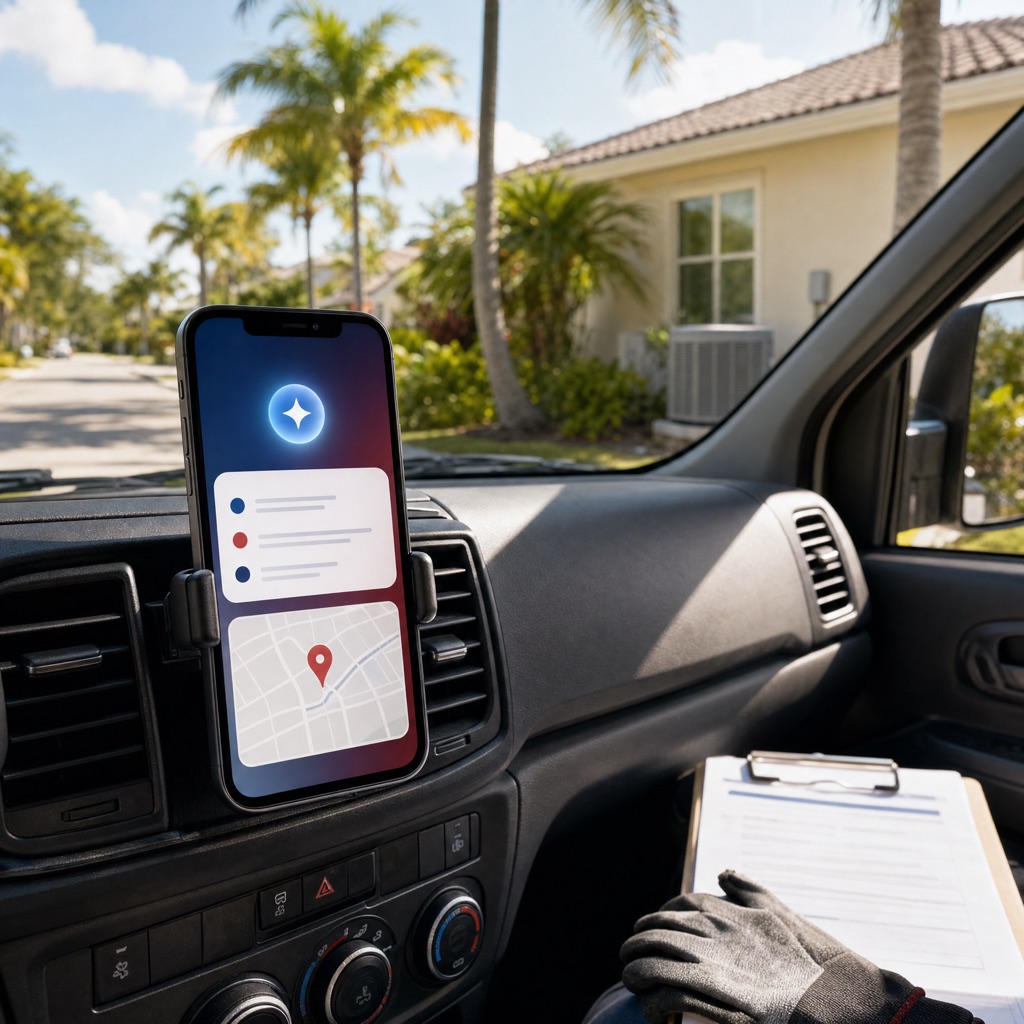
Not long ago, a homeowner with a broken AC typed four words into Google: "AC repair near me." Today, in Google's AI Mode, the same person can type the whole situation: "My AC stopped cooling, I live in Kissimmee, who can come today and tell me the price before they start?" Google says the average AI Mode search is triple the length of a traditional search query.
That longer question changes what your business needs to have written down. The customer no longer gets only a list of links to sort through. They get a written answer, and Google decides which businesses it mentions and what it says about them.
What AI Mode and AI Overviews are, in plain words
AI Overviews are the AI summaries that appear at the top of many Google results. AI Mode is a separate, conversational way to search: you ask, you get a written answer with links, and you can keep asking follow-up questions.
A few dates, taken from Google's own announcements:
- Google introduced AI Mode as an experiment in March 2025 and opened it to everyone in the U.S. in May 2025, with no sign-up.
- In September 2025 it launched AI Mode in Spanish worldwide.
- In May 2026 Google said AI Mode had passed one billion monthly users.
So a Spanish-speaking customer in Orlando and an English-speaking customer next door can both ask the AI, each in their own language, and each one gets a different answer built from what Google finds.
Where the answers come from, according to Google
Google describes a technique it calls "query fan-out." AI Mode splits a question into subtopics, runs searches for each one at the same time, and then puts the findings together. Google's help center says responses are "supported by high quality web content." In its first announcement, Google also named the Knowledge Graph and real-time information among the sources.
For a local business, two Google documents matter most:
- Google's guidance on AI features for site owners lists keeping your Business Profile information up to date among its best practices. It also says there are "no additional requirements" to appear in AI Overviews or AI Mode, and no special optimizations. A page needs to be indexed and eligible to show a snippet.
- Google's Business Profile help center explains that profile information comes from your official website, licensed data from third parties, people who contribute facts, photos and reviews, the owner, and Google's own interactions with the business.
And one honest warning, from Google itself: "AI Mode doesn't always get it right."
The new part: Google may call your business
Here is what many owners haven't noticed. In July 2025 Google announced that Search can call local businesses to ask about pricing and availability on a customer's behalf. The customer searches something like "pet groomers near me," chooses the option to have AI check pricing, answers a few questions, and Google makes the calls.
Google's Business Profile help center lists the kinds of automated calls it makes: booking appointments, checking restaurant wait times, and confirming the price and availability of products and services. The customer receives an email or text with your quote. Google also says information you give on these calls may be added to your Business Profile on your behalf.
In May 2026 Google announced it would extend this to select categories such as home repair, beauty and pet care, rolling out to everyone in the U.S. that summer.
That means whoever answers your phone is now part of how you appear on Google. A vague answer, an old price or a schedule that changed last month is exactly what reaches the customer.
You decide whether to take these calls. Google says businesses stay in control through their Business Profile settings: More, then Business Profile settings, then Advanced settings, under "Google automated calls and text messages." Turning them off is a valid choice. If you keep them on, prepare your team with a short, true answer for the questions they will hear.
What you control, and what you don't
What you don't control:
- Whether AI Mode mentions you for a given question.
- The exact words it uses, or which competitors appear next to you.
- Your position. Google states there is no way to request or pay for a better local ranking.
What you do control:
- The accuracy of your Business Profile: hours, special hours, services, categories and phone number.
- What your website says, in text Google can read.
- Your reviews, and how you reply to them.
- Whether your name, address and phone number match everywhere.
- Whether you accept Google's calls, and how your team answers them.
Turn the longer questions into answers that exist
Longer questions carry more objections. Every detail the customer adds is a doubt, and every doubt needs a true answer written somewhere Google can find it. Google's advice for its AI experiences points the same way: people are asking "longer and more specific questions," so unique, helpful content is what counts.
| What the customer asks AI Mode | Where the answer must exist |
|---|---|
| "My AC stopped cooling, who can come today and tell me the price first?" | Hours and same-day policy on your profile; a service page that explains the diagnostic visit and how you quote |
| "Dentist near me that takes my insurance and sees kids on Saturday" | A current insurance list on your website, Saturday hours on your profile, and children's care listed as a service |
| "Spanish-speaking accountant for small business taxes near me" | Spanish pages written natively, a profile description that says it, and the specific service named |
| "Plumber who gives a written estimate before starting" | A question on your website's FAQ with your real process, reviews that mention it, and your replies confirming it |
| "How much does a water heater replacement usually cost?" | A page that explains what changes the price, and a clear answer your team gives if Google calls |
None of these answers is a keyword. Each one is a fact about how you work. That is why the work starts by listening to your customers, not by opening a keyword tool. And because the questions change with the season, a new competitor or a hard review, the list has to be revisited every month.
What to work on, month after month
- Ask AI Mode about your own business once a month, in English and in Spanish, using the long questions your customers really ask. Take screenshots.
- Fix the source when something is wrong: your profile, your website or an old directory listing. Use the thumbs-down button to report the answer.
- Update your profile whenever hours, services or seasons change.
- Add answers to your website from the questions you hear on the phone, one at a time.
- Reply to reviews, each reply written for that customer. Google says positive reviews and helpful replies can help your business stand out.
- Ask your team about the calls. Did Google call this month? What did they say?
- Measure what sells. Google suggests looking past clicks to conversions, including information lookups about your business. For a local service business, that means calls, messages and booked appointments.
AI helps with much of this. It can sort hundreds of reviews by topic, turn call notes into a first draft of an FAQ, and flag listings that still show an old phone number. What it can't do is decide what is true about your business, or how to answer a hard question with care. That takes a person who knows the business.
Questions to ask an agency before you hire one
- How will you check what Google's AI Mode says about my business, and how often?
- Will you test the questions in English and in Spanish?
- How will you learn the questions my customers ask before they book?
- Do you know about Google's automated calls, and will you help my team prepare for them?
- Which number will you report to me each month: rankings, or calls and bookings?
- Do you promise a spot in AI answers? (If the answer is yes, keep looking.)
If you want a starting point, our audit checks how your business appears in AI answers and where your information doesn't match.
The short version
Google's AI Mode answers local questions with a written response built from what it finds on the web and in Business Profiles, and Google can now call your business to ask about price and availability. Nobody can promise you a place in those answers. What you can do is make sure the facts are true, written down in both languages, identical everywhere and kept current, and that whoever answers your phone knows what to say.